Sunday, April 12, 2009

Perihan Mağden's Two Girls

I've been deeply touched by a very strong novel: İki Genç Kızın Romanı ("The novel of two girls", translated by Brendan Freely and published as Two Girls in English), by Turkish author and columnist Perihan Mağden. The novel has also been adapted to the cinema by Kutluğ Ataman. I like Mağden because she speaks/writes her mind, and in Turkey, this is not an easy task. She is of course criticized by many and has even been prosecuted by the Turkish government because of the views she expressed on mandatory military service. In this novel, Mağden depicts the lives of two teenage girls in Istanbul. The polar tone of the novel strengthens the feeling of oppression, especially for a girl in a male dominant environment. The force of Mağden's third person omniscient narration also lies in the encounter of these two characters, the angry Behiye and the naive Handan. Both girls are coming from very distinct backgrounds: Behiye is the sister of an older brother and the daughter of a conservative family she hates, and Handan is the unique daughter of a prostitute she loves. Since the very moment they meet, Behiye sees Handan as her saviour: the beautiful girl who will save her from her life, her brother, her mother who cries all the time... Behiye hates life, she doesn't like herself much either, until she finds Handan and grabs her to the core. Their bond is beyond friendship and sisterhood, it is almost amorous. The murders of boys happening all around Istanbul together with Behiye's unreasonable attitude and open hatred against the world (especially towards men) intensify the sense of danger and threat. This impossible relationship is told in an incredibly honest and down to earth language. The word plays are brilliant (and I guess a real challenge to translate). This is an excellent work of contemporary literature and I believe quite original in the current Turkish literary scene.

The cover of the Turkish edition of the novel published by Merkez Kitapçılık ve Yayıncılık (Istanbul, June 2006, 255 pages)

Tuesday, March 24, 2009

Elif Shafak's Journey between Languages

Most of you might know how strongly I always objected to people saying that one can only write in his or her own native or first language. I am now so relieved to read Elif Shafak's column of 17 March. For those of you who cannot read Turkish, I would like to share some of her views here. Shafak starts her article explaining how people like to ask her why she is writing in English, and even sometimes argue that by writing in English, she becomes a writer of English language literature. "It isn't so!" she says and argues that today, when so many people are living and growing up and get educated in different languages, live in different countries, move so much, we shouldn't put people into such narrow categories. Elif Shafak is writing both in English and in Turkish, not only is this important for the author, but it is for the reader. I don't feel the same when I read her work when the original version is English (like The Bastard of Istanbul or The Saint of Incipient Insanities) or Turkish (like Mahrem or Bit Palas). I always prefer to read books in their original written language, the same goes when I watch movies. Whenever possible, I prefer the original version. And in case of Elif Shafak's work, I can join her in the journey between languages because luckily, I understand both Turkish and English. I sometimes have more trouble understanding Shafak's work in Turkish because she uses a very elaborate vocabulary with many ancient Turkish words (I love to learn by the way!). And this is what I love about her work, this "journey between languages" as she likes to put it. It is also a journey for her readers, at least it is for me.

Her last novel published in Turkey and in Turkish, Ask (pronounced "Ashk", meaning "Love") is the example of such an adventurous and passionate journey. Shafak has written the novel in English and had it translated into Turkish by Kadir Yiğit Uz. Then she reworked on the Turkish version, so in a sense, Ask "has been written again". In her column, Shafak also fairly explains that it isn't an easy task for a writer to express him or herself in a different language and that it would simply be madness if one wouldn't simply love working like that. She offers a wide range of examples of writers who have been writing in different languages and in languages which aren't their first, like Nabokov, Beckett, or Conrad (whose English Virginia Woolf heavily criticized). Well yes, they are all among the best writers of the 20th century so no doubt that were successful.

I am fascinated by languages and I myself speak five. I do certainly not master them all the same way but all of them open different doors of the world to me, make me experience different cultures, teach me different visions and ways of life, and offer me such a wide range of possibilities to express myself. So I think I do know what Elif Shafak is sharing with her readers and I do applaud her for the way she shakes herself, her readers and literature to its very core.

Elif Shafak's column in the Newspaper Zaman appears twice a week.

Saturday, March 14, 2009

Birmingham

I've been to Birmingham for a couple of days last week and was quite impressed by the city. I've only heard very negative things about it, not less than "Birmingham sucks" "It's boring!" or more simply: "There's nothing in Birmingham!" So maybe I was impressed because I had very low expectations, but still, I do think it's a pretty city.

Birmingham has been through great changes in the last few years. And having such a young and diverse population must help the city being dynamic and full of creativity.


If you ever go to Birmingham, try to wander around and look at the nice buildings and definitely stop by the Waterstones bookstore on 128 New Street, whether it's for the books or the building itself.


Photos: Statue on Victoria Square, inside Waterstones, Facade of Waterstones on 123 New Street

Thursday, March 12, 2009

Inspired by Amy Güth

American author, editor, festival founder Amy Güth has posted a very fun video on her blog: "About my Shoes" I love reading her posts and if I could find her novel Three Fallen Women (out of print) I would certainly read that too. If I go to Chicago, I'll sure try to attend one of her events. This post is to tell Amy that I also like taking pictures of my shoes everywhere! Here are some:

My shoes in Lubeck:
My shoes in Sevilla:

My shoe in Granada:
Vive les shoes!

Wednesday, March 11, 2009

What's in a name?

Is one's whole identity in a name? What does it say about where one comes from? Does it say anything about where one goes? Would one be different if named differently? Does one try to escape their identity by using a pen name? I'm sure you all would have different answers to these questions. I have some I'd like to share. Many people who know me as Canan ask me where the name Ayse come from? Well... Ayse is actually my first name and it appears on my passport , driver's licence, identity card, my diplomas, and therefore on my plane tickets, bank cards, on my door bell. Canan has been amputated by officials and only appears as a C. on all these documents. Most people call me Canan because it's how my parents and friends have been calling me for the last 29 years. And for 29 years my name has been transformed to Conan, Chanan, Shanan, Kanaan and so on. I always felt I had a different name outside Turkey. The pronunciation was changing with the geography where it was spoken. The closest to the Turkish pronounciation would be Janan or even Jaanan. I only bother correcting people when they pronounce K, but I don't mind if the J becomes CH or SH. Some friends and colleagues call me Ayse, and most people only need to pronounce my name once, so I never correct the latter bunch. The correct pronounciation would sound Ayshe.... so if you chose to call me Ayse...
Does my name cover my whole identity? Thank God no! It helps understanding my history, it says where my name comes from, and one can guess where I or my family might come from too. As for where I go and how I'd be going if I had another name, I cannot say. I am just happy I have two names I love and that belong to me, because both have been offered to me by my parents.
Since I moved to the Netherlands, it got even easier to avoid the confusion: on all official paperwork you're only asked to write down your "Hoofdletter", the first letter of your surnames. Happy me, I'm now A.C.! My name journey will never end, fortunately.

Sunday, March 8, 2009

Books & Brussels

One of my favorite activities when in Brussels is to wander in bookstores. Not that there are none in Amsterdam (there are plenty and very high quality bookstores like Athenaeum Boekhandel), it's just that I miss being surrounded by books written in French when I enter a bookstore. Athenaeum has a fairly good section of French speaking books and I can always order online. But I still love going to a bookstore, seeing what's new, discovering some jewel of a book chosen by the employees that month, or just touching the hard and paper back covers, opening and going through the pages. So last week I've been to Tropismes for the wide choice of fiction, theatre and poetry, to Brüsel for the graphic novels and comic books but also the very nice gallery, and although impersonal and too big I've been to FNAC (avoid the place on Saturday!) because of the wide space. Here are some titles I've bought during my visits:
"Entre les murs" by François Bégaudeau (you will certainly know the adaptation to cinema from Laurent Cantet: "The Class"), "De cendres et de fumées" by Philippe Blasband and "Pyongyang" by Quebecois graphic novelist Guy Delisle. Other acquisitions are translated works: "Le Dieu Manchot" by José Saramago, "Le voyage dans le passé" by Stefan Zweig and two mangas: "The Outsider" by Gou Tanaber and"Le Champ de l'arc-en-ciel/Nijigahara Holograph" by Inio Asano.

My hunger for books has been satiated during my stay in Brussels. The Brussels Book Fair began when I was still there! I've spoken to some authors, discovered new publishing houses, listened to Enki Bilal talk about his new work ANIMAL'Z , lied to Joseph Joffo about willing to buy one of his books but claiming I needed to go to the ATM (I have read "A Bag of Marbles" in high school and didn't want to buy old fashioned editions of his books - but there's no excuse, I feel bad, I shouldn't lie!), discovered the work of Karin Tuil during her talk and listened to interviews of authors on the radio on my way back home to Amsterdam, a bag full of publisher catalogs, promotional bookmarks and books on the passenger seat.

Wednesday, January 28, 2009

Visit Amsterdam!

I've been preparing a short virtual visit of Amsterdam for the Virtourist website the last few weeks, and finally it is ready and online! You can visit this wonderful city which has been my home for more than a year now by clicking here. Enjoy!
Photo: Klovenierburgswal by Erinc Salor

Saturday, January 24, 2009

Blank...

I haven't got the opportunity to post anything for a while. I have also been really lazy these last weeks (except during my trip in South Korea which was a delightful experience!). I haven't written a line for weeks now, my short stories are still waiting on my hard drive and somewhere in my mind. Ideas are still alive but structure is nowhere around! I will give myself some time, not too long though, but just enough to get back to work and being productive! Feels good even to write about it now!

Me upside down at the Film Museum in Mole Antonelliana , Torino, Dec 2007 (photo by Erinc Salor)

Monday, December 15, 2008

Hopeful Apology

Academics Prof. Ahmet İnsel, Prof. Baskın Oran, Dr. Cengiz Aktar and journalist Ali Bayramoğlu have started an online petition aimed at all Turkish people to sign and affirm their feelings of injustice about the negation of the Armenian massacres of 1915.

Here is a translation of the statement that you can read in Turkish on the homepage of the website www.ozurdiliyoruz.com ("özür diliyoruz" means "we apologize"):
My conscience does not allow me to deny and be insensitive to the Great Catastrophe experienced by the Ottoman Armenians in 1915. I reject this injustice, for my own part share my fellow Armenian brothers and sisters' feelings and pain, and apologize from them.
After you enter your name and other relevant details, you have to click on "özür diliyorum" (I apoligize) to sign the petition.

Among the supporters of this hopeful initiative are famous writers, activists, artists and more like Cem Özdemir, Nilüfer Göle, Murathan Mungan, Nedim Gürsel, Perihan Magden ...(see the complete list under "Destekleyenler" on the homepage of Ozur Diliyorum).
I can only applaud such an initiative but do acknowledge that the way to reach real understanding and reconciliation between the two nations has been extremely slow and full of denials during the last 90 years. There is still a lot to do, and if signing the online petition can help taking a step forward, I have no other choice than taking action and start with an apology.

Also read Sarah Rainsford article on BBC news and the Turkish newspaper Radikal's short report.

Sunday, November 16, 2008

Sinterklaas arrives to Amsterdam!

I was sitting in my living room on this nice and quiet Sunday morning, when I suddenly heard boat horns and music arriving from far. The entertaining sounds started approaching quickly, and I couldn't let my curiosity sleep and jumped out of the comfy couch to have a look out from the window. Loads of boats with people dancing on it were passing on the "Nieuwe Herengracht" canal next to my apartment, with excited kids and adults on the street hailing at them. On the boats (dancing) and in the streets (running, dancing and cycling), there were plenty of people with their faces painted in black and wearing colorfoul costumes who were distributing candies to the kids: these were Zwarte Pieten! Only then had I finally understood what was happening: "Sinterklaas is coming!", have I shouted in the living room. My partner gave a suprising glance at me: "Sinter who?" "Look at the Zwarte Pieten! Sinterklaas is coming!" My excitement wasn't convincing to him: "What Pitt?".
I remember celebrations of Saint-Nicholas when I was living in Belgium. As a kid, I loved the fact that we could eat loads of marzipan (I even thought we could only find marzipan at this time of the year, which fortunately isn't true), I never really believed in Saint-Nicholas (or in Santa Claus), but I still liked the celebrations (what kind of kid wouldn't like receiving gifts and candies?). Every year on 6 December, the Dutch and the Belgian celebrate Sinterklaas in honour of Saint-Nicholas (klaas is a nickname for Nicolaas), the patron saint of children, sailors, merchants, pawnbrokers and Amsterdam, which I honestly didn't know until I read it in the Lonely Planet Amsterdam. The white-bearded man dressed as a bishop arrives to Amsterdam every year in mid-November (I didn't know it would be today) by ship from "Spain" and enters the city on a horse to receive the keys of the city from the mayor (Mayor Cohen did it in front of the Scheepvaartmuseum today).
He is of course followed by his Zwarte Pieten who, apart from throwing candies to the kids are also carrying sacks to take the naughty ones away (which they of course never do during the parade). The idea is that well-behaved kids receive gifts in a shoe they've placed next to the chimney with a carrot for the patron's horse. One Zwarte Piet climbs down the chimney and puts the gift in the shoe, and I suppose takes the carrot away for the horse, since I cannot imagine the horse climbing down the chimney (as if I could imagine a man with a face painted in black doing the same!). The North American Santa Claus evolved from the Sinterklaas celebrations at the Dutch settlement of New Amsterdam (today's New York).
I've seen Amsterdammers going crazy celebrating New Year and the Queen's Birthday on 30 April, and today the arrival of Sinterklaas to their city. I have been amazed again by their capacity of getting together and celebrate. Today's party goers were the kids, the young ones and old ones!
Photos taken on the Prins Hendrikkade, Amsterdam

Friday, October 31, 2008

Literature and Identities

I was just reading an article about contemporary German literature in the French newspaper Le Monde. It basically explains how much richness and diversity immigrants living in Germany and writing in German have brought to contemporary German literature. In addition to talking about immigrants, I would have added that many writers whose parents were immigrants and whose first language might be other than German, have now chosen to write in German. Anyway, I must admit that I am a bit difficult about the use of terminologies like "immigrant" or "mother tongue", so let's say it's fair enough to use it broadly in this case. But what I don't understand is the parenthesis in the following sentence, where the author reports from the Frankfurt international book fair, in which Turkey was the guest country of honor this year:

...au-delà des écrivains turcs invités, bien d'autres, qui vivent en Allemagne et ont choisi d'écrire en allemand (le pays compte 3,4 millions de musulmans dont une majorité de Turcs), occupent désormais une place de choix dans le paysage littéraire : Feridun Zaimoglu, Emine Sevgi Ozdamar ou Hatice Akyün, notamment, ont enrichi ces dernières années la littérature germanophone de leur imaginaire et de leurs trouvailles stylistiques.

When talking about the Turkish authors living in Germany and who have chosen to write in German, she feels the need to tell us that Germany counts 3.4 million Muslims, from which a majority are Turkish. Can someone explain to me what this information has to do with writing in German or being Turkish? What does it add to our understanding of contemporary writing in Germany? It doesn't even tell us how many people from Turkish origin live in the country, so it doesn't add any relevant information, except that the author is making a serious amalgam here between country of origin and religion! Personally, I don't mind being called "Turkish", because among many others, it's one of the adjectives that indeed adds relevant information to who I am. I would accept "Muslim" to some extend, but even there I might find it odd to chose it as a first way of describing myself. As for "immigrant", it is a word that certainly wouldn't help describing me. It could even be misleading because I haven't really emigrated from anywhere, my parents did. They didn't ask for my opinion when I was in my mother's belly. The only thing that being called an immigrant would do to me is, alienating me from my parents country (because I have supposedly left it) and from the place where I live, and where I am supposed to feel home. How would you like to be called then, will you say? Don't call me one thing, I am from Turkish descent, yes, and I am a Turkish citizen. I am also a Belgian citizen and a resident of the Netherlands. I am speaking five languages, and mastering writing in at least three. So no, if I am going to be published one day, supposedly in French, I would not like to be called an immigrant writer! I had enough of that. Everyday life is narrow enough to put people into boxes, so I do believe we can do better in the literary, and in any artistic and creative domains for that matter. Of course ethnic, religious and cultural frameworks can influence creativity, and it does add a lot to the overall picture, but literature gives so much more space to writers and their readers. It's an immense area where we can move beyond frontiers, go much further than everyday life.

I would like to end with a quote from 2000 Nobel Laureate for Literature Gao Xingjian, from a speech given at the inauguration of the last edition of Kosmopolis, an international Literature festival held from 22 to 26 October in Barcelona:
"When literature becomes a hymn of praise for a country, the flag of a nation, the voice of a political party or mouthpiece of a class or group, it can be used as a powerful and crushing instrument of propaganda, but it loses its intrinsic nature ..."

Wednesday, September 24, 2008

Love story between a Fairy and a Wizard

Author Laurel Snyder asked of the blogosphere, "What is your favorite book from childhood?", and following Amy Guth's post on her blog I am now telling you about one of my favorite childhood books: L'Enchanteur by René Barjavel. I think I must have read that book four times. It was one of our French class reading assignment and it luckily came in during my I'm-crazy-about-Arthurian-legend period. I would definitely suggest it to anyone who reads French (I'm afraid it has never been translated into English, please correct me if I'm wrong).

Written in 1984, L'Enchanteur could be seen as yet another novel based on the Arthurian legend, but Barjavel manages to make much more of it. He freely transforms the story into a romance: one between Merlin the Wizard (L'Enchanteur) and the Lady of the Lake Vivian. I still vividly remember the tenderness that links both characters (I can still hear Viviane's soft voice in my head). The main theme remains of course the quest for the Graal, and many other well known heroes appear in the novel: King Arthur, Perceval, Queen Guenièvre and Lancelot, whose love story is also quite powerful in Barjavel's narrative. The author plays a lot with conventions through voluntary anacronysms as well, introducing for instance tin cans and an electric chimney into the medieval story. Nevertheless, the main theme of this magical novel remains LOVE. The love story between kings and queens, knights and queens, between Vivian and Merlin, the Fairy who could see the human in the Wizard.

Photo: Cover of the Paperback edition - Collection FOLIO

Saturday, September 13, 2008

The Sincerity of Margo Rabb

Remember I wrote about Margo Rabb and her essay about Young Adult literature in the New York Times this summer. I have finally had the chance to read her latest novel “Cures for Heartbreak” (better later than never!). I had searched for it in several bookshops in Amsterdam and in Brussels, and since I couldn’t find it I simply ordered it online. After being away for a month, I was back home and “Cures for Heartbreak” was waiting for me…

The only family grief I have ever experienced was the loss of my grandfather four years ago. It was sad but in no way comparable to loosing one’s parent. So I had absolutely no idea how it must be like to lose one’s mum at the age of 15. I still don’t have a clue of course and I will never; because I am 29 and my mother is still alive and in good health. The day she will be gone, I will experience grief, but not like a 15 year old girl. I have been deeply touched by Margo Rabb’s narrative. I am not going to discuss why it is a YA novel or why it should or shouldn’t be, simply because I am no specialist in the field and also because no matter on what shelve the book has been placed, I am only interested in sharing my feelings about its content and not about its label. But the subject in itself is quite fascinating and really interesting. Many writers and reviewers have discussed the subject of YA literature on the blogosphere (check Colleen Mondor’s blog Chasing Ray among many others and of course Margo Rabb's essay on the NYT).

"Cures for Heartbreak" starts with Mia, her sister Alex and their father choosing a coffin for their mother’s funeral. “We’re in a play in which the funeral is the last act” says the father for the fifth time in two days. It all indeed looks so surreal: one day, Mia’s mother is diagnosed with cancer, “If she dies, I’ll die” writes the young 15 year old girl in her diary, and twelve days later, she dies But Mia doesn’t. She carries her grief everywhere, because this kind of love never dies but it hurts deeply. Throughout the novel, I was immersed in Mia’s world, in her fears, her doubts, her wishes, her friendships, her laughs and even her grief. Michael Chabon puts it absolutely right when he writes that the novel is “(…) sad, funny, smart, (and) endlessly poignant (…)” As she explains in the afterword, Margo Rabb has based herself on her own experience to write this novel. However, what makes the book magical and real is not that it contains autobiographical elements, but the sincerity of the narrative voice. Mia is not Margo, she is a fictional character and she has a life on her own, she is free from any psychological therapy many authors are unfortunately producing throughout their characters. This why I loved “Cures for Heartbreak” and I strongly recommend it to everyone, no matter how old. The still unconvinced ones can start having a look at Margo Rabb’s original and really enriching blog Books, Chocolate, Sundries where you will meet plenty of other fascinating authors presented through Margo's eyes. Again, always in a very sincere way.

Wednesday, July 23, 2008

Erykah Badu The Enchantress

Erykah Badu is unique. She has proved it once again tonight on the stage of Paradiso in Amsterdam. I had the chance to see her perform at the Cactus Festival in Bruges two years ago and there already I was amazed. But tonight's concert was divine. Paradiso is of course a great place to listen to good music, it's not too big (it has a capacity of just over thousand people) and is one of Amsterdam's most beautiful concert venues. Right from her entrée, Ms Badu set the atmosphere: it was going to be an explosive night. Erykah Badu has the allure, the voice, the charisma, the humility, the talent, the humour, the beauty, the humanity... and I believe a lot more. Erykah Badu is a Diva. Erykah Badu is an Enchantress. Dressed to kill, super sexy yet classy, Ms Badu sang to us from her last album "New Amerykah Part One (4th World War)" without forgetting some songs from her beautiful "Mama's Gun", "Baduizm" or "World Wide Underground". Two hours and a half of outstanding vibes made the whole audience rise. At one point, Ms Badu stepped down of the stage to walk among the crowd. The Diva is close to the people, "not black people, not white people, not latinos, not asian... not blue, not green, not purple, all people!", constantly inviting it to rise higher and higher. So we all did, and I myself got so high that I can't get down yet. Some little voice inside me says I will stay under the enchantment for quite a long time.

Tuesday, July 22, 2008

Margo Rabb, she's YA and she's OK!

Thanks to a very well written essay about Young Adult literature published in the New York Times Books Update of 21 July, I have discovered an even nicer author. Her name is Margo Rabb, she is a writer of YA books ... and more (she also writes for adults). If you want to know more about YA and her work, read her essay entitled "I'm Y.A., and I'm OK" and visit her website. She also has a blog called "Books, Chocolate, Sundries" (it's about books and food... a delight!). She has only started blogging in the end of June, so it's not too late to catch up! Her last book Cures for Heartbreak (pictured above) has received praise from Michael Chabon (you can read it on Margo Rabb's homepage), and I hope to review it on this blog soon.

Tuesday, July 15, 2008

Cuento Illustrado

Here's a very nice illustrated story I found today. The author of the work is Angela Davila and you can follow her on Issuu. Enjoy!

Festival of Early Music in Utrecht

From 29 August to 7 September the Oudemuziek Festival will take place in Utrecht. Check their website to see the full programme. Great ensembles like Le Poème Harmonique, Huelgas Ensemble and Capilla Flamenca will enchant the festival.

Sunday, July 13, 2008

When the Rivers of the World lead to the North Sea...

... they gather almost 70,000 jazz lovers to their shores. The marathonesque programme of this year's North Sea Jazz Festival has been almost perfect, despite the badly controlled heat (not a single artist could get on stage without pointing out the almost unbearable heat in the different rooms!). This is not such a small detail of course but not big enough to spoil the high quality of this internationally reknown festival. Held since 2006 at the Ahoy complex in Rotterdam, it had its home in The Hague during 30 years. A bigger venue was indeed necessary to host the hundreds of artists performing for 3 days in the different rooms named after the world's most impressive rivers.


The main focus of t
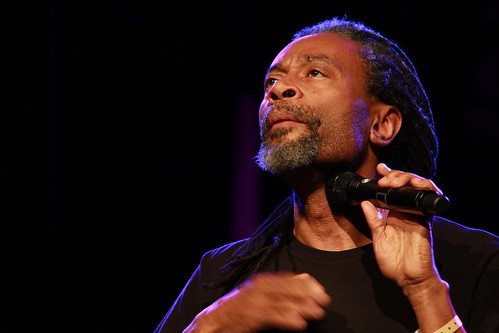
his year's North Sea Jazz Festival has been on vocal interpretation, with Bobby McFerrin (photo above) as artist in residence. My Friday evening started with a nice performance by Cassandra Wilson on the DARLING, followed by a not-so-jazz-but-still-able-to-be-jazz illustration of Fink's amazing talent on the YUKON and ended with an energetic Angie Stone on the NILE. I was in the meantime swimming on other rivers discovering new sounds, like the very surprising Esra Dalfidan who also gave an interview and acoustic performance in the NRC Media Café.


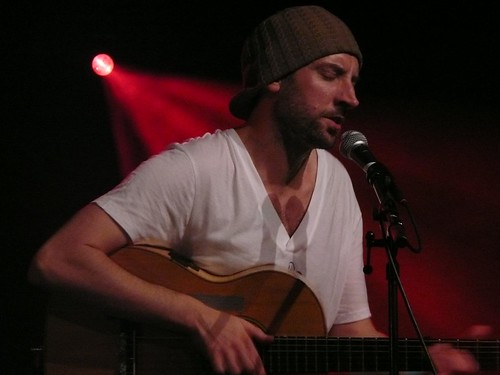
"We're not really a jazz band" says Fink (photo above) sitting on his chair, guitar in hand, looking at his bassist and laughing, "but we'll do our
best to be jazz tonight". I'd discovered Fink through his album Biscuits for Breakfast in a small restaurant in Brussels called La Cuisine -which is unfortunately closed now. Its owner, inviting up to 18 guests in his kitchen, was listening to Fink every time I was eating there. "I'm going to ask him a percentage on his album sales" he was saying "everyone eating here wants to get his album!" Whenever I listen to Fink, I think of the nice and cosy Cuisine. So Fink at the North Sea Jazz was kind of unmissable for me and it reminded me of some nice and warm Foccacia's plenty of good Bresaola... (speaking of food, the catering at the Festival was really something). It was an amazing concert with an incredibly open and generous audience, which made Fink feel even more at ease and generous. Altogether with his drummer and bassist, they've interpreted songs from Biscuits for Breakfast and some new I still have to discover. Friday night ended with some dancing on Angie Stone's good vibes.


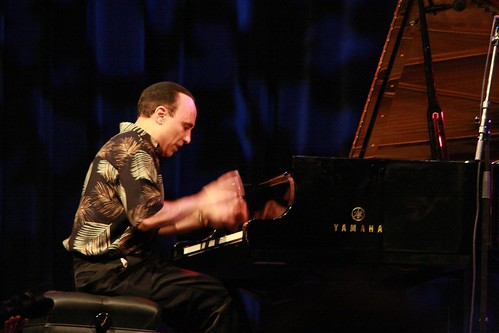
I have started my Saturday jazz parcours, again at the DARLING, with Bobby McFerrin, Richard Bona and Cyro Baptista, three monsters of improvisation gathered for a one hour performance! That concert was the kind that shakes you to the core. I could feel the tears running on my cheeks! McFerrin even stepped down the stage to get closer to his audience and make three women sing with him. An unforgettable experience! Leaving that river full of emotions has been hard, but the next musician who was waiting for us in the HUDSON was also one of a kind... Michel Camilo (photo above)! What a piano master! I cannot say anything more here, just look at his hands on the photo above and judge for yourself. Together with his trio, they have delivered one terrific music moment.
After such an apocalyptic jazz exploit, I could only afford myself to take short glimpses of Chaka Khan and Toto Bona Lokua and hit the road back to Amsterdam.
Sunday, the last day of the festival had arrived. But no mourning, it has been a greatly enjoyable adventure, starting with Yael Naim, getting some Brad Meldhau in-between and ending with a kingly Youssou n'Dour (photo below).


I must say that I have been impressed by Yael Naim's performance in the very cosy MURRAY room. Luckily, I found myself a seat one hour before the concert even started, and the room quickly got full (and too warm, again). She might have been on the American charts thanks to her song that appears on the MacBook Air commercial, together with her friendly band, she proved that she could do some more. A talented new soul! Brad Meldhau has been a completely different experience, which I will certainly renew (especially if they decide to come to the Bimhuis very soon). The festival marathon has ended on a musically rich tone with Mr Youssou n'Dour: "Africa is not only about AIDS or poverty, Africa is also about happiness and joy!" he said while making the thousands of people gathered on the NILE dancing like crazy. For that night, and during the whole festival, it was all about great rhythm, good food, a lot of dancing, unexpected discoveries and true emotions.

All photos taken during the North Sea Jazz Festival (c)Erinç Salor

North Sea Jazz Festival took place from 11 to 13 July 2008 at the Ahoy in Rotterdam
Next Year's festival will take place from 10 to 12 July 2009
www.northseajazz.com

Sunday, July 6, 2008

Le Petit Parachutiste

For those of you who can read French, here's my prize winning short story "Le Petit Parachutiste"
I hope you'll enjoy it!